
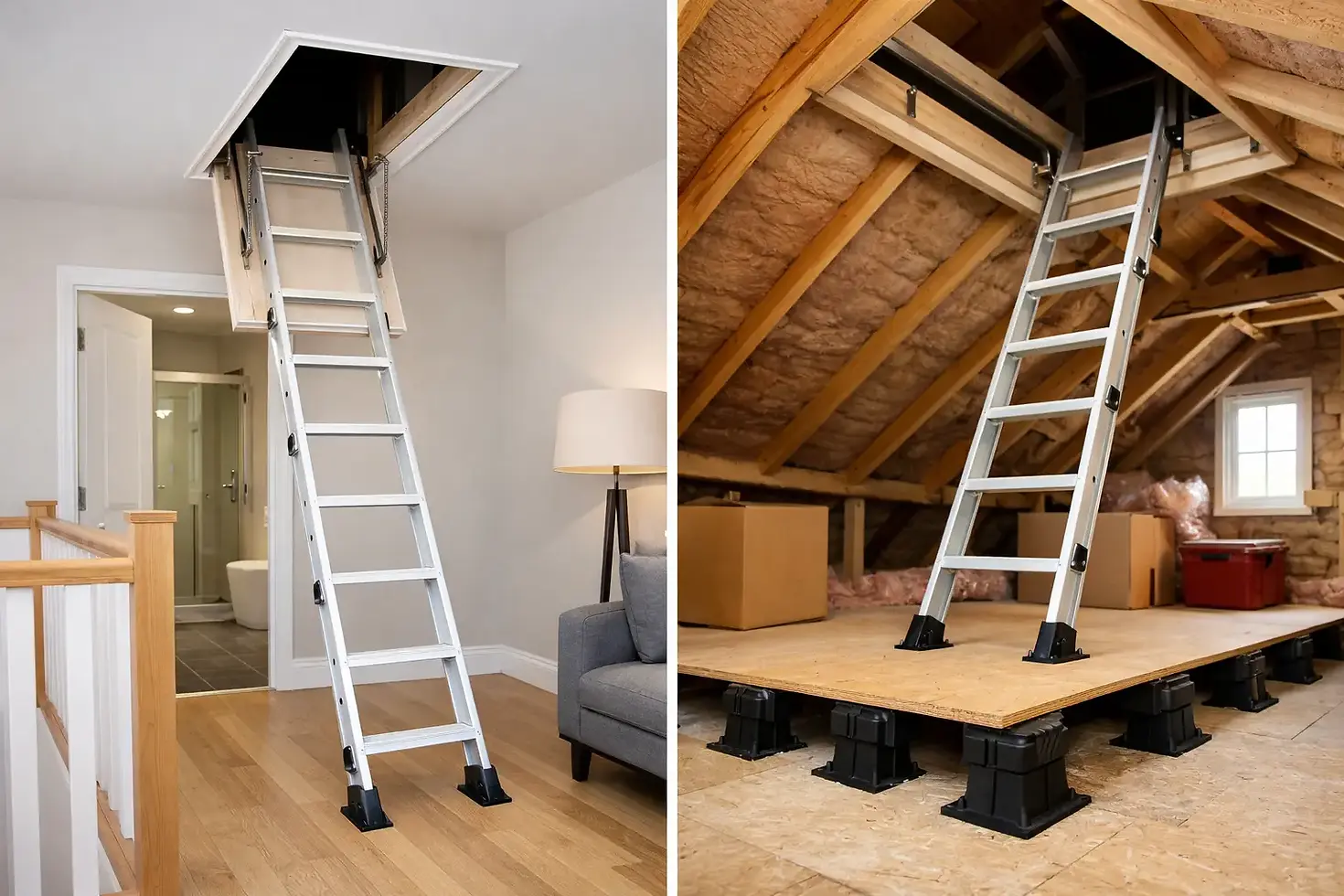
Can Loft Ladders Be Fitted Anywhere?
You do not usually find out whether a loft ladder will work until you are stood under the hatch, tape measure in hand, realising the landing is tighter than you thought. That is why homeowners often ask, can loft ladders be fitted anywhere? The honest answer is no - but they can be fitted in far more places than most people expect, provided the access point, loft structure and ladder type are properly assessed.
That matters because loft access is not just about squeezing a ladder into a hole in the ceiling. It needs to be safe to use, practical for the space below, and suitable for the loft above. A good installation should make the loft easier to reach without creating awkward clearance issues, damaging insulation, or leaving you with something that feels unstable every time you climb it.
Can loft ladders be fitted anywhere in a house?
In most homes, a loft ladder can be fitted somewhere, but not always in the exact spot you first had in mind. The location has to work both at ceiling level and inside the loft. You need enough room for the hatch, enough landing space for the ladder to open, and enough headroom so it can be used safely.
The biggest restriction is often not the loft itself, but the area below it. A hallway may seem like the obvious place, yet the swing of the hatch and the angle of the ladder might clash with walls, doors, banisters or stairs. In some houses, the best answer is to enlarge the existing hatch. In others, it makes more sense to relocate it slightly to achieve a safer setup.
This is why a proper survey matters. A loft ladder is never just chosen from a catalogue and fitted blind. The surrounding space has to be measured properly, and the loft structure checked before any recommendation is made.
What decides where a loft ladder can go?
Several practical factors decide whether a position is suitable. The first is the hatch opening. Many older homes have small loft hatches that are fine for peeking into the loft, but not ideal for regular access. If the opening is too small for the type of ladder needed, it may need widening or replacing altogether.
The second is clearance below. Folding and sliding loft ladders each need a different amount of floor space when opened. If the landing is narrow or there is a door directly beneath the hatch, one ladder style may be ruled out while another remains perfectly possible.
The third is the loft structure itself. Joist direction, trusses, cables, pipework and the position of the water tank, if there is one, can all affect where the hatch sits and how the ladder is fixed. Newer homes can be especially sensitive here because insulation depth and NHBC-related good practice need to be respected. Simply boarding over insulation or forcing access into the wrong position can create bigger problems later.
Then there is headroom. A loft ladder should allow you to get in and out of the loft without crouching into rafters or stepping awkwardly onto unsupported ceiling areas. If the access point opens into a cramped section of roof space, the ladder may technically fit but still be poor in day-to-day use.
Hatch size and ceiling opening
A lot of access issues start with the hatch. Some are too small for comfortable use, especially if you want to lift boxes, decorations or suitcases in and out. If the hatch is undersized, a new hatch and frame can often solve the problem.
That said, enlarging a hatch is not always straightforward. Ceiling joists and surrounding timbers need to be considered so the opening can be altered safely. This is another reason a made-to-measure approach works better than guesswork.
Space on the landing or in the room below
Even when the loft itself is suitable, the room below may not be. A loft ladder needs enough operating space to come down at the correct angle. If it opens into a cramped first-floor landing, over a staircase, or into a room with fitted furniture directly beneath it, that can limit your options.
This does not automatically mean the idea is off the table. Concertina ladders, telescopic ladders and compact folding models can work well where floor space is limited. The key is choosing the right product for the layout rather than forcing a standard ladder into a non-standard space.
Loft layout above the hatch
People often focus on the ceiling opening and forget what happens once they are through it. If the hatch opens into the lowest part of the eaves, access can feel awkward from the first use. Ideally, the ladder should bring you up into a part of the loft where you can stand or move safely onto boarded storage space.
That becomes even more important where loft boarding is planned. Safe access and usable storage need to work together. There is little benefit in having a ladder if you step straight into compressed insulation or onto exposed joists.
The type of loft ladder makes a big difference
When people ask can loft ladders be fitted anywhere, they are often really asking whether there is one ladder that suits every home. There is not. Different ladder types suit different properties, and fitting success often comes down to matching the ladder to the space.
Sliding ladders are simple and reliable, but they usually need more handling and can be less convenient for regular use. Folding timber or aluminium ladders are a popular middle ground because they store neatly in the hatch and offer good ease of use. Telescopic and concertina ladders are useful in tighter spaces, though there can be a trade-off in terms of comfort underfoot compared with a wider, more traditional ladder.
If you use your loft often, convenience matters just as much as fit. A ladder that technically works but feels awkward every weekend soon becomes a frustration. For households using the loft as proper storage, a sturdier, easier-to-operate option is usually worth it.
Older homes and new builds have different considerations
Older houses can present awkward hatch sizes, uneven joist spacing or limited landing space, but they often give a bit more flexibility in the loft itself. New-build homes are a different story. They may have cleaner layouts, yet insulation depth, trussed roofs and compliance-related concerns mean the installation needs more care.
This is where homeowners can come unstuck by treating access and storage as separate jobs. If a loft ladder is added without thinking about insulation and boarding, it is easy to reduce the loft's thermal performance or create unsafe storage areas. A better approach is to look at the whole setup together - hatch, ladder, boarding, lighting and insulation depth.
For homeowners in South Yorkshire, that joined-up approach is often the difference between a loft that is merely reachable and one that is genuinely useful.
When a loft ladder cannot go in the original position
Sometimes the answer is not yes or no, but not there. That is common in houses where the existing hatch sits in the least convenient spot because it was only ever meant for occasional access. If the landing is too tight, the loft above too restricted, or the opening too small, moving the hatch a short distance can transform the result.
A relocation does need careful planning. Ceiling structure, room layout and the route into the loft all need checking. But where the current opening is impractical, repositioning it can produce a far safer and more comfortable setup than trying to make do.
At Doncaster Loft Boarding Solutions, this is often where practical experience matters most. The right answer is not always the cheapest-looking option on day one. It is the one that gives you safe, reliable access and works properly with the rest of the loft.
What to expect from a proper assessment
A proper assessment should look at more than just the hatch dimensions. It should consider the height of the ceiling, the amount of clear floor space below, the loft's internal layout, and how often you plan to use the access. It should also take account of whether you want simple occasional access or regular access to a boarded storage area.
That conversation matters because the best solution for storing Christmas decorations once a year is not necessarily the best solution for a family using the loft every week. One setup may be compact and budget-friendly, while another offers better comfort, durability and ease of use. Neither is wrong. It depends on the home and how you intend to use the space.
A good installer will talk you through those trade-offs clearly. No jargon, no pressure, just straight advice based on what will work in your property.
So, can loft ladders be fitted anywhere?
Not literally anywhere, no. But in many homes, there is a workable solution once the space is assessed properly. The hatch may need enlarging, the ladder type may need adjusting, or the access point may need moving slightly. What matters is getting a setup that is safe, practical and suited to the way you actually use your loft.
If you are thinking about better loft access, it helps to look beyond the ladder on its own. The best results come when access, storage and insulation are planned together, so your loft becomes easier to use without compromising the performance of your home.
The right loft ladder should not feel like a compromise. It should feel like the point where wasted space finally becomes useful.



Comments