
Best Insulation for Boarded Loft Spaces
If your loft is already boarded, or you are planning to board it, the insulation underneath matters just as much as the storage above it. The best insulation for boarded loft spaces is usually the option that keeps heat in without being squashed flat by boards, feet, or stored boxes. That is where many lofts go wrong. A loft gets boarded for convenience, but the insulation gets compressed, airflow is affected, and the home can end up colder and less efficient than before.
For most homes, there is not one single answer that suits every property. The right setup depends on the loft structure, the depth already in place, whether it is a newer build, and how much usable storage you actually want. A good loft boarding job should work with the insulation, not against it.
What makes the best insulation for boarded loft use?
In a boarded loft, insulation has to do two jobs. It needs to reduce heat loss through the ceiling below, and it needs to keep doing that job once the loft becomes usable. If the boards sit directly on top of the insulation, the material gets flattened and its performance drops. You might gain storage space, but you lose thermal efficiency.
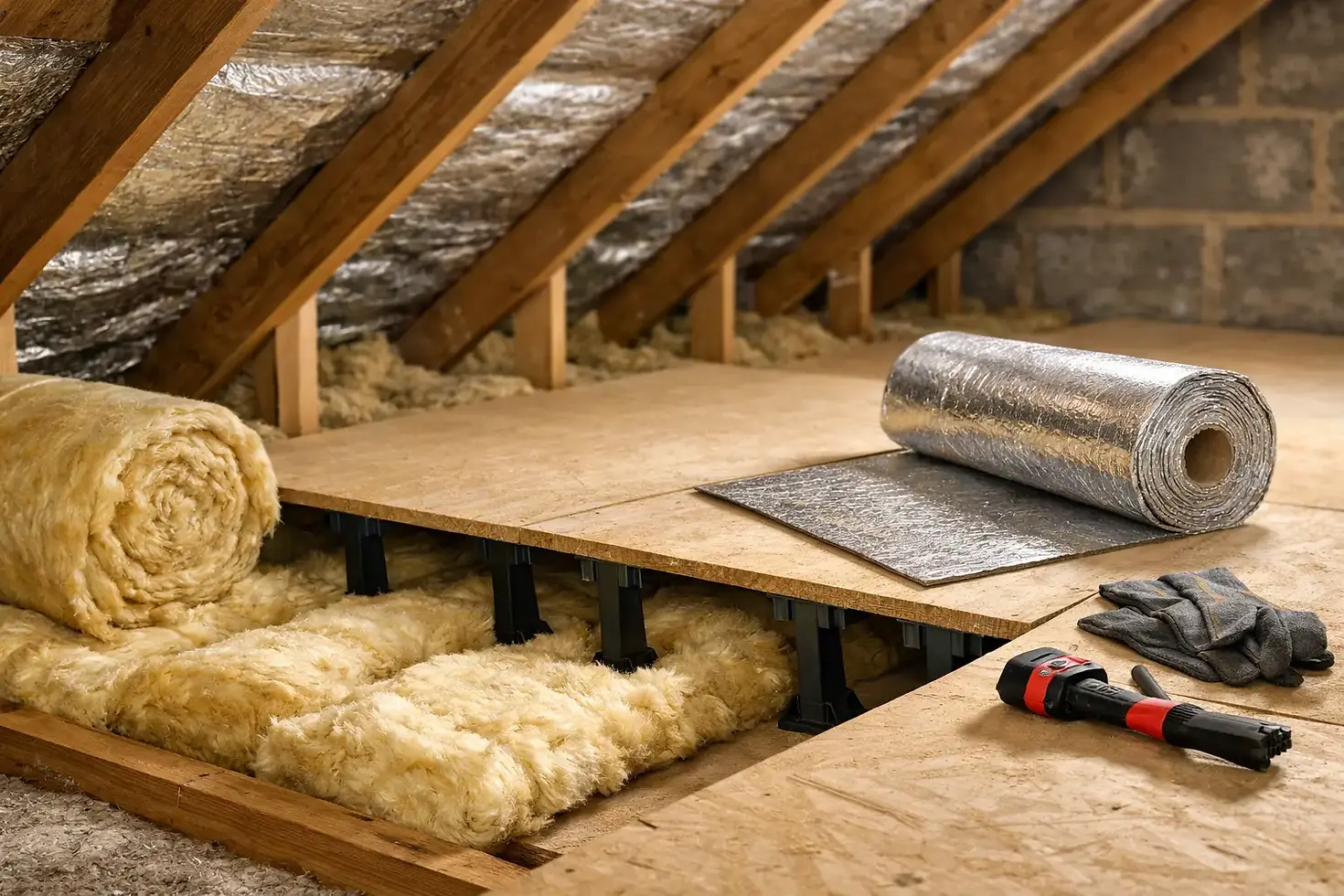
That is why the best insulation for boarded loft installations is not just about material choice. It is also about preserving the correct depth. In many properties, especially newer homes, loft insulation should not be compressed to make boarding easier. A raised loft boarding system allows insulation to stay at the proper thickness while still creating a safe decked area above.
This is often the difference between a loft that looks tidy for six months and one that remains practical and energy efficient for years.
Mineral wool - still the most common choice
For many UK homes, mineral wool remains the standard loft insulation, and for good reason. It is cost-effective, widely used, and performs well when fitted to the correct depth. It also suits the layout of most loft floors because it can be laid between and across joists.
If you are boarding over loft insulation, mineral wool can still be the best option, but only if the boarding is raised above it. When it is left uncompressed, it offers strong thermal performance for the price. It is particularly suitable where the aim is to improve storage without turning the loft into a habitable room.
The drawback is that mineral wool is not load-bearing. You cannot lay boards straight on top and expect the insulation to keep working properly. It can also be awkward to work around if the loft has cables, pipework, or uneven areas. Even so, for straightforward storage lofts, it is usually the practical starting point.
Rigid insulation boards - useful, but not always the first choice
Rigid boards such as PIR insulation are sometimes seen as a smarter or slimmer option because they can provide good thermal performance with less thickness. In the right setting, that is true. They are often used in roof slopes, loft conversions, or more specialised insulation upgrades.
For a standard boarded storage loft, though, rigid boards are not always the simplest or most cost-effective route. They need accurate cutting, careful fitting, and attention to gaps. If badly fitted, the performance can fall short of expectations. They also tend to cost more than mineral wool.
Where rigid insulation does make sense is in lofts with limited depth, awkward detailing, or where a more tailored thermal upgrade is needed. Some properties benefit from a mix of insulation types rather than relying on one product throughout. That is why a proper look at the loft is more useful than guessing based on product labels alone.
Why raised loft boarding usually matters more than the insulation brand
Homeowners often ask which insulation product is best, but the bigger issue is often how the loft is boarded. Even very good insulation will underperform if it is crushed under chipboard. A raised boarding system solves that problem by creating a gap above the insulation, allowing it to remain at full depth.
This is especially important in modern homes where insulation depth is greater than older joists were designed to accommodate. New-build owners in particular need to be careful. Compressing insulation or making ad hoc changes in the loft can create problems with performance and, in some cases, with compliance expectations.
A raised system also gives a safer, more stable storage platform. Instead of balancing boxes on top of insulation or making do with narrow boarded strips, you get proper access and a defined area for storage. From a practical point of view, that tends to be the best long-term result.
Best insulation for boarded lofts in older homes
Older houses around Doncaster and South Yorkshire often have lofts with shallower joists, patchy existing insulation, or previous DIY boarding that was fitted directly on top of the insulation. In these homes, the best approach is usually to remove the guesswork, assess what is already there, and upgrade both the insulation and the boarding method together.
Mineral wool is often still the best fit because it can be topped up to improve thermal performance. Once that depth is in place, raised boarding can be installed above it. This gives you the storage you wanted in the first place without undoing the benefit of the insulation.
There are cases where part of the old insulation should be replaced, especially if it is damp, damaged, or poorly fitted. But in many lofts, a sensible upgrade is more about correcting the boarding setup than starting from scratch.
Best insulation for boarded lofts in new-build properties
New-build lofts need a more careful approach. They are often built with energy efficiency in mind, and the insulation depth can already be significant. The trouble starts when homeowners want storage and someone lays boards straight onto the joists because it looks quicker and cheaper.
That shortcut usually costs more in the long run. The insulation gets compressed, the thermal benefit is reduced, and the loft becomes less efficient than intended. In some newer properties, that kind of alteration can also raise concerns about meeting expected standards.
For these homes, the best insulation for boarded loft use is often the insulation already specified for the property, kept at its proper depth and protected by a raised boarding system. In simple terms, the clever part is not replacing decent insulation with something thinner. It is creating usable storage above the insulation you need to keep.
What about spray foam?
Spray foam gets mentioned often, but for a standard boarded storage loft, it is rarely the first recommendation. It is a very different type of insulation system and is usually applied to the roofline rather than the loft floor. That changes how the loft behaves as a space.
It can also create complications for ventilation, future roof work, and property surveys. For homeowners who simply want a safe, insulated loft for storage, it is generally more solution than the job requires. A well-insulated loft floor with raised boarding is usually the cleaner, more practical option.
The real question - insulation only, or insulation plus boarding?
If your loft is hard to access, full of insulation rolls, and not much use for storage, the answer is rarely to flatten everything and throw boards over the top. The better answer is to treat the loft as a system. Insulation, boarding, access, lighting and hatch size all affect how useful that space becomes.
That is why many homeowners end up doing the job twice when they go down the DIY route. They board it cheaply, realise the insulation has been compromised, then need to redo it properly. A professional installation avoids that false economy.
For most households, the best insulation for boarded loft spaces is mineral wool kept at the correct depth under a raised boarding system. It is practical, proven, and well suited to homes where the aim is storage and energy efficiency rather than a full loft conversion. In some lofts, rigid board insulation has a place, but it is usually part of a more specific design rather than the default answer.
At Doncaster Loft Boarding Solutions, that is the thinking behind raised loft systems. The goal is not just to board a loft and move on. It is to create useful storage while protecting the insulation that keeps the house warmer below.
If you are weighing up your options, the best next step is usually not choosing a product off the shelf. It is finding out what your loft can support, what insulation depth it needs, and how to board it without compromising the job. Get that part right, and the loft becomes genuinely useful instead of just looking finished.



Comments